
Thinking about buying a peptide synthesizer but not sure what it actually does? This guide breaks the whole process into plain steps. No chemistry degree required. By the end you will see why the right peptide synthesizer is less about a single feature and more about running the same loop reliably, again and again.
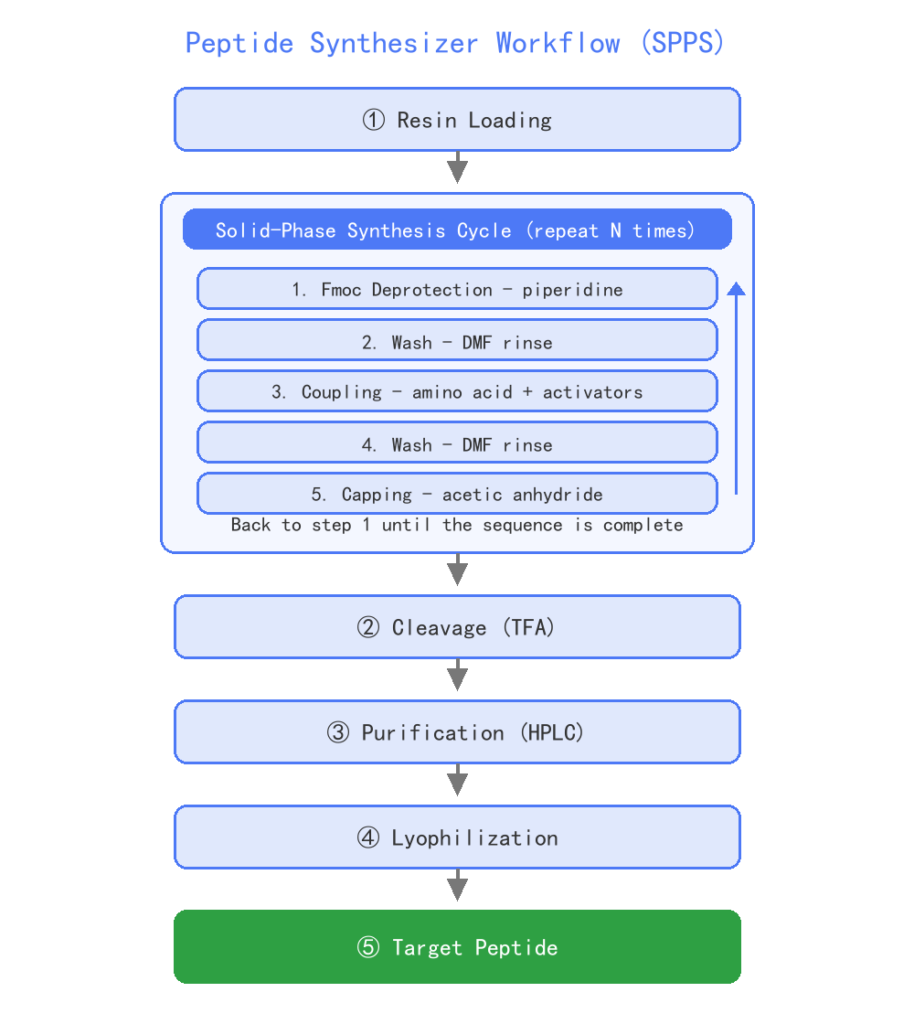
Step 1: Load the resin and let it swell
The peptide grows on tiny plastic beads called resin. You load the resin into the reaction column and soak it in solvent so the surface opens up. A peptide synthesizer handles this automatically, timing the soak so every batch starts the same, and the peptide synthesizer then holds the resin at the right temperature while it swells. Skipping or rushing this step is a quiet way to lose yield later, which is exactly why letting the instrument control it pays off.
Step 2: Remove the cap (deprotection)
Each amino acid wears a temporary cap, usually Fmoc, so it only reacts where you want. Before adding the next one, the instrument washes in a mild base that dissolves that cap. A peptide synthesizer meters the base and rinses on a fixed clock, which is far steadier than doing it by hand. We cover Fmoc versus Boc in a separate guide if you want the deeper comparison.
Step 3: Add the next amino acid (coupling)
With the cap off, the next activated amino acid flows in and joins the chain. This is the step where coupling efficiency lives or dies. A peptide synthesizer with controlled pre-activation pushes that efficiency up, and our models with low-temperature pre-activation do the activation cold to keep sensitive residues from racemizing. Better coupling here means less truncated product downstream, and a cleaner crude before purification.
Step 4: Wash away the leftovers
After coupling, the column is flushed to carry off unused reagent and byproducts. A peptide synthesizer tunes wash volume automatically, using just enough solvent to clean the column without wasting it. Good washing shows up as a cleaner HPLC trace, even though you never see it happening.
Step 5: Repeat until the chain is done
Deprotect, couple, wash, repeat. That is the whole loop. A ten-amino-acid peptide runs ten cycles. The more cycles, the more a steady instrument matters. A single-channel peptide synthesizer is ideal for developing the method, while a multi-channel system pays off once you repeat a validated protocol at scale. Match the peptide synthesizer channel count to how often you repeat the same protocol, and the math for your batch size becomes straightforward. If you are weighing scale against budget, our buying guide lays out the trade-offs in plain terms.
Step 6: Cleave the peptide off the resin
When the chain is complete, a TFA-based cleavage cocktail releases the peptide from the resin and strips the side-chain caps at the same time. A peptide synthesizer handles this aggressive cleavage inside a sealed path, so the operator stays clear of the acid. The result is crude product, still loaded with resin fragments and reagents. This harsh step is why solid-phase and liquid-phase routes feel so different in the lab, a contrast we explain in our SPPS versus LPPS breakdown.
Step 7: Purify and check
The crude peptide goes through preparative HPLC, then analytical HPLC and mass spectrometry confirm it is pure and the mass is correct. In our on-site commissions, the peptide synthesizer and these two checks run together so the result is verified before we leave, exactly as described in our thymopentin case study. Purification is where the real product finally appears.
What a good peptide synthesizer actually buys you
Put the steps together and the story is consistency. A peptide synthesizer repeats the same loop with the same precision, which is why yield and purity hold batch after batch. From the PepAxis-Nova 1 R&D unit for method scouting, through the Atlas series for pilot runs, up to the ACT Tetras 106-channel system for high throughput, the difference between models is mostly how many loops you can run at once and how much manual attention each needs. Pick the peptide synthesizer sized to your typical batch and the workflow largely runs itself.
Bottom line
A peptide synthesizer loads resin, removes a cap, couples the next amino acid, and washes, over and over, then cleaves, purifies, and validates. The machine is not magic; it is disciplined repetition. Buy the peptide synthesizer that fits your sequence length and volume, and you turn a finicky manual craft into a repeatable process. A peptide synthesizer that matches your weekly batch count is worth more than one with features you never use. Ready to compare models? Visit PepAxis to see single-channel and multi-channel peptide synthesizer options side by side, or contact our team for a configuration recommendation.
Still deciding which peptide synthesizer matches your lab? Reach out and we will map a system to your target peptide and batch size.
E-mail : echoliu@dilunbio.com