
A peptide synthesizer gets you the crude peptide. What happens next decides whether your batch meets spec or ends up as waste. Most labs buy a peptide synthesizer first and treat purification as an afterthought, and that order causes most of the quality problems we see in the field. Purification is the half of the job that most buyers underestimate, so this guide walks through it the way we set it up on the bench: pre-treatment first, chromatography in the middle, lyophilization at the end.
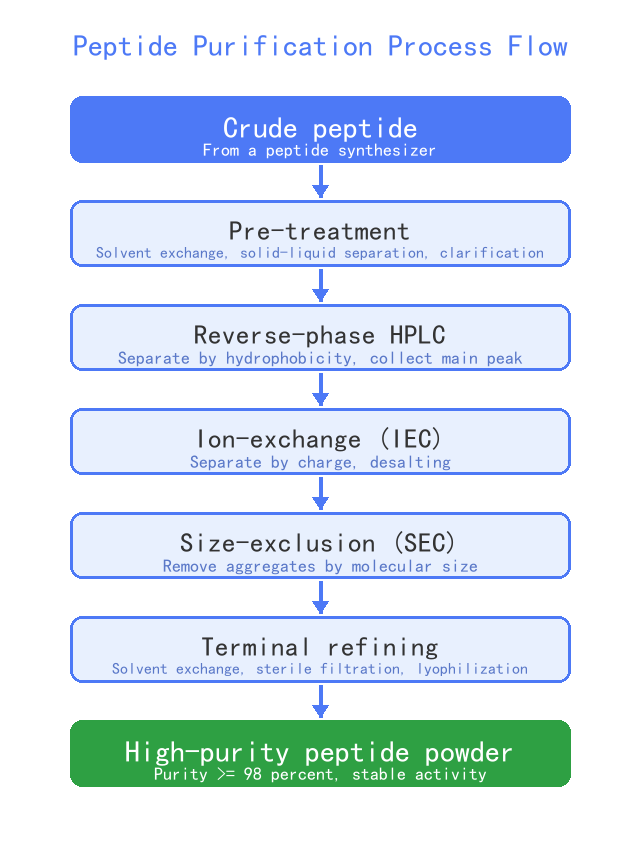
1. Why Crude Peptide Needs Work Before It Ships
Straight off a peptide synthesizer, the crude material is messy. Truncated sequences, deletion sequences, isomerization by-products, resin fragments, protecting-group leftovers, salts, and leftover solvent all sit in the same pot. You cannot formulate or sell that. The purification train is what separates the target from everything else, and it is where product quality is actually locked in.
When you size a peptide synthesizer, keep the downstream purification load in mind. A cleaner synthesis step means a lighter purification step, and that shows up directly in your yield and lead time.
2. Pre-treatment: Get the Crude Feed Clean First
Pre-treatment is the unglamorous front end that protects your expensive chromatography columns. Skip it and you will be replacing media far too often. A peptide synthesizer that delivers a cleaner crude makes every downstream step cheaper, so getting pre-treatment right pays back fast.
2.1 Solvent Exchange and Low-temperature Concentration
Right after the peptide synthesizer cleavage and settling, the system goes into closed vacuum concentration at low temperature. Ether, TFA, and acetonitrile come off without heat, so the peptide does not degrade or racemize. You also finish solvent exchange here so the feed matches the later water-based purification.
2.2 Closed Solid-liquid Separation and Washing
A filter-wash-dry three-in-one unit runs the crude cake through repeated low-temperature rinse and slurry wash cycles. Residual salts, small-molecule impurities, and protecting-group debris wash out, and resin bits and insoluble particles are removed. The loop stays closed, so there is no solvent smell in the room and no chance of outside contamination.
2.3 Aqueous Dissolution and Clarification Filtration
Dissolve the washed crude in ultrapure water, adjust pH for solubility, then run it through coarse, 0.45 micrometer, and 0.22 micrometer filtration in sequence. You end up with a clear feed that will not clog your purification columns.
3. The Three Chromatography Methods You Actually Use
Every peptide synthesizer output we have handled eventually meets one of these three separation methods. Most batches use all three in sequence.
3.1 Reversed-phase HPLC (RP-HPLC)
This is the workhorse and the one we recommend building capacity around first. When you spec a peptide synthesizer, ask how the crude will feed your RP-HPLC, because that handoff sets your recovery. RP-HPLC separates on hydrophobicity, which differs between your target peptide and its deletion, truncation, and isomer impurities because their chain length and amino-acid make-up are not the same. With C18 media, an acetonitrile and water mobile phase, and gradient elution, you collect the main peak by retention time. A good RP pass takes crude from 40 to 60 percent purity up past 98 percent. That is the number most GMP and pharmacopoeial specs ask for.
3.2 Ion-exchange Chromatography (IEC)
Getting the peptide synthesizer output into a clean, desalted feed is exactly what IEC is for. IEC separates on charge and is the natural desalting step before RP. It suits water-soluble, weakly hydrophobic peptides and strips charged impurities and salt ions that would otherwise stress your RP system. Run it at the right buffer pH and your downstream peptide synthesizer to purification handoff stays smooth.
3.3 Size-exclusion Chromatography (SEC)
SEC is the last guard before release, whatever peptide synthesizer made the batch. SEC separates on size. Big aggregates and protein junk cannot enter the porous media and wash through first, while small impurities and salts get held back. It is the final polish before release, knocking out dimers, polymers, and stray residues so the product is uniform and stable.
4. Terminal Refining and Lyophilization
The peptide synthesizer output, now purified, is still not a finished product. The collected high-purity fractions are not a finished product yet. Solvent exchange, de-acidification, desalting, sterile filtration, and freeze-drying finish the job. Reverse osmosis, dialysis, and graded water washing pull out residual solvent, acid, and salt. A 0.22 micrometer sterile filter handles bioburden, then low-temperature vacuum freeze-drying removes water without heat. What comes out is a loose, stable, active peptide powder.
5. Four Controls That Keep Your Batch on Spec
5.1 Keep It Cold
Peptides break down with heat. Concentration, purification, and washing all stay cold to avoid chain cleavage, oxidation, racemization, and isomerization.
5.2 Stage the Purification
Pre-treatment, then ion-exchange desalting, then RP fine separation, then SEC polish. Each stage removes a different impurity class. This staged logic is exactly why pairing the right peptide synthesizer with the right purification setup matters more than chasing a single hero machine.
5.3 Stay Closed
Solid-liquid separation, washing, and concentration run in closed equipment. No open pots means no contamination and no solvent release, which is what GMP clean production demands. The same closed-design thinking you want in a peptide synthesizer applies here too.
5.4 Control pH Tightly
Tune pH to the peptide’s isoelectric point. Better solubility and selectivity mean less loss on the column and a higher recovery at the end.
6. Putting the Synthesis and Purification Line Together
A modern peptide synthesizer and a well-designed purification train are two halves of the same line. The synthesizer makes the crude; purification makes it shippable. If you are scoping a new line, design both ends together instead of buying a peptide synthesizer first and hoping the downstream will catch up.
Explore our peptide synthesizer range and see how the synthesis and purification steps are built to hand off cleanly: PepAxis peptide synthesizer lineup
Email: echoliu@dilunbio.com