
You bought a peptide synthesizer to make peptide, not to babysit it. The good news is that most downtime is predictable, and almost all of it is avoidable. This is the maintenance routine we set up for labs that run their instruments hard, plus the five faults we see most and exactly how to clear them.
Why a Maintenance Routine Pays Off
A peptide synthesizer that misses a coupling because of a clogged line or stale reagent does not just lose one run. It burns amino acids, resin, and a full day of bench time. A ten-minute flush after each run is the cheapest insurance you will ever buy. Instruments that get a real routine outlast the ones that only get attention when something breaks.
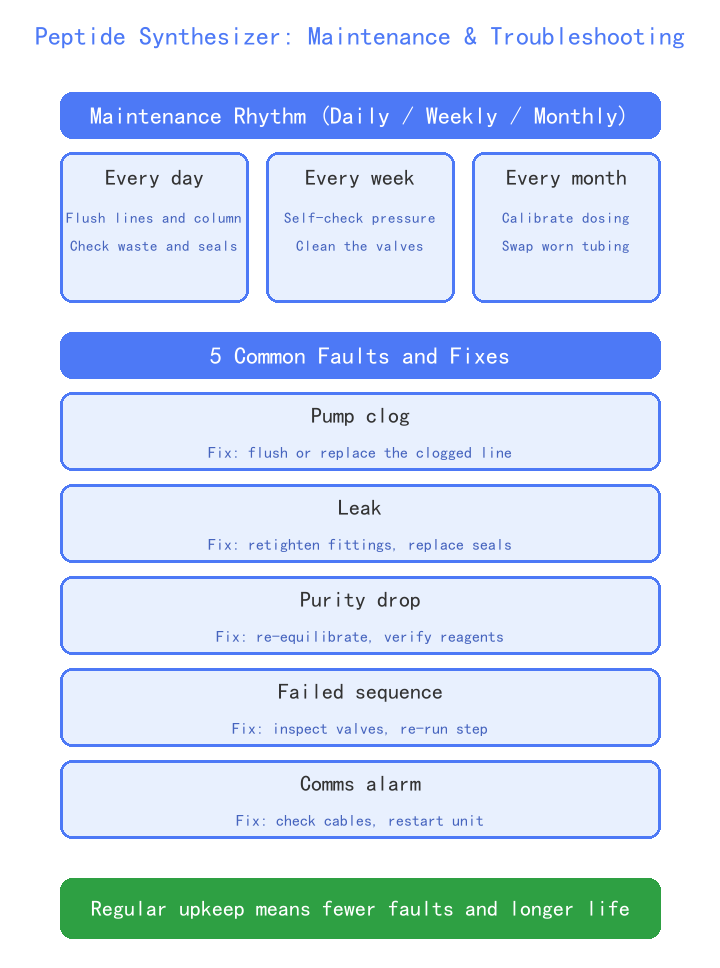
Your Day-Weekly-Monthly Checklist
Every day
- Flush fluid lines and the reaction column so nothing dries inside your peptide synthesizer.
- Check the waste bottle and the seals before you walk away.
Every week
- Run the self-check on your peptide synthesizer and watch the pressure curve for spikes.
- Clean the valves so particles do not start lodging.
Every month
- Calibrate flow and dosing so your peptide synthesizer adds the right amount every time.
- Swap any tubing that looks hard or discolored.
The Five Faults We See Most
1. Clogged column
Pressure spikes, flow drops. Back-flush first, then replace the column. A peptide synthesizer that is flushed daily almost never hits this.
2. Leaking fittings
Tighten, then inspect the seal. If it has flattened, replace it. Keep a spare seal kit on the shelf so a leak never becomes a wait.
3. Coupling efficiency drops
Check reagent age and solvent water content first. A peptide synthesizer is only as good as the reagents you feed it, and expired activating agents quietly wreck yields.
4. Purity falls
Look at deprotection and washing. Sometimes a few extra seconds of wait time on your peptide synthesizer recovers the purity you lost.
5. Sequence errors
Verify the sequence and the bottle mapping before every run. A peptide synthesizer runs what you tell it, so the error is almost always in the setup, not the machine.
Consumables: What to Replace and When
Resin has a rated life, use it and swap it. Seals, filters, and tubing should have a hard expiry date even when they still look fine. The cheapest peptide synthesizer downtime to avoid is the kind you plan for with a consumables log. For any peptide synthesizer, that log is the single best habit to build.
Get More Years Out of Your Peptide Synthesizer
- Stable environment: steady temperature, low dust, controlled humidity.
- Grade-managed solvents with water content you actually monitor.
- A use-and-fault log so the same problem never repeats.
- A peptide synthesizer that is logged and serviced on schedule simply lasts longer.
- A scheduled deep service, not just break-fix.
Need a Peptide Synthesizer Built to Be Maintained?
If your current instrument spends more time in repair than in production, it may be time to look at hardware designed for easy service. Our peptide synthesizer line uses quick-swap columns, accessible valves, and clear maintenance prompts so routine care stays routine.
E-mail: echoliu@dilunbio.com